
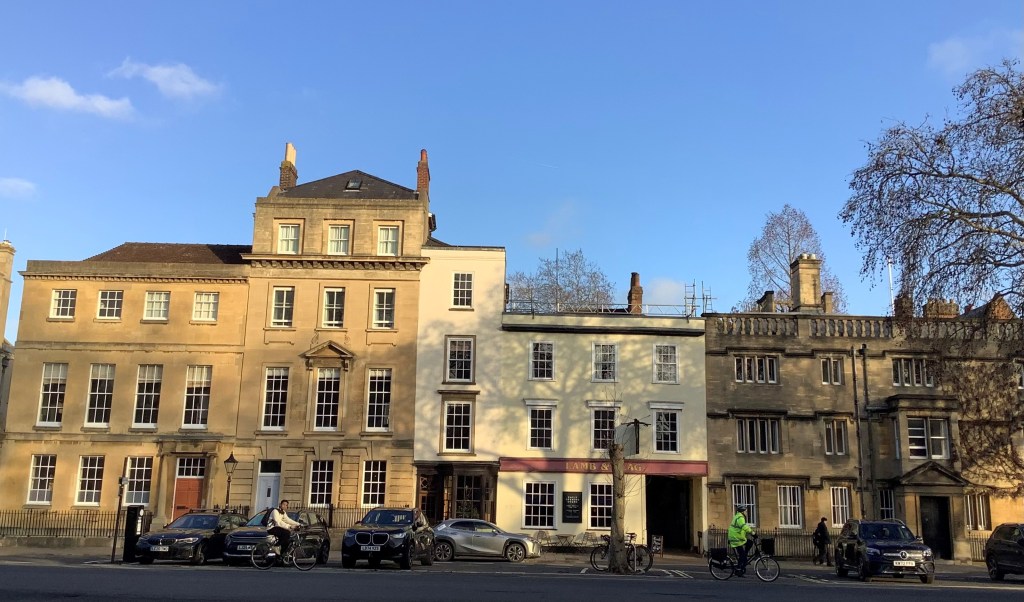
I am not the landlord of the historic Lamb and Flag pub on St Giles’ in the heart of Oxford. Owned by St John’s College and on its current site since 1613, the pub featured in episodes of Morse, was a favoured watering hole for Graham Greene in his student days, and might be the inspiration for part of Thomas Hardy’s novel, Jude the Obscure (possibly the most depressing thing I’ve ever tried to read despite a colleague’s delighted assessment that the whole point of the book is that there is no redemption).
I am not the landlord of the Lamb and Flag but if things had come to a different conclusion in 1918 the pub might now be a key driver of Campion Hall’s development plans, and be the space where I set up my laptop on the two days a week that I currently spend in Oxford working up a strategic imagining of the Hall’s future needs and the potential for supporting students and scholars for generations to come.
For correspondence exchanged in 1918 between the Provincial of the Society of Jesus in Great Britain and Fr Charles Plater SJ, Master of Campion Hall from 1915 until 1921, reveals a serious proposal for the purchase of the pub from St John’s College.
At that time Campion Hall occupied numbers 11, 13, 15, and 15 on St Giles’. Obtaining either a lease, or better still the freehold, on number 12, the building occupied by the Lamb and Flag, ‘the filling in the sandwich’, would enable the Hall to make better use of space and expand student numbers.
Plater was in very good standing with his neighbours at St John’s, and indeed across the University of Oxford. 1918 was also the year in which he successfully concluded negotiations for the University to adopt a new statute allowing the foundation of Permanent Private Halls, a development from the temporary status of private halls that enabled students in residence to be full members of the University.
A couple of years earlier Plater had taken on the lease of the upper floors of the medieval octagonal chapel that is now part of Hertford College, providing the four Catholic halls with the space to run public lectures and house a reference library. He was clearly an effective organiser and networker who had a clear sense of how Catholics might play a full part in the life of the University and be seen to be making a real contribution to scholarship.
The correspondence suggests that Plater had discussed the possibility of buying the Lamb and Flag with St John’s College and they were amenable to the idea. The Jesuit Provincial, Plater’s Superior in the English Jesuits, agreed that funding could be made available subject to clarification on the income that might be generated. A short while later a note to Plater brought the glad news, “Father General sanctions the purchase of the Lamb and Flag.”
And there the material in Campion Hall’s archive runs out. Clearly the purchase did not go ahead and perhaps there is more in the Jesuit archives in London or in the archives of St John’s College, but for now we can indulge in a little conjecture. Perhaps the turmoil of war brought other priorities to the fore or the purchase might have been curtailed once it became clear that Campion Hall really needed a purpose built college building on another site. Sixteen years later it would be this scenario that came to fruition with the completion of the premises on Brewer Street designed by Edwin Lutyens.
 Colin Brady