
I’ve known Jean Yves, the undertaker of Rochechouart, for nearly twenty years, and as he is president of the town’s committee for the Ostensions I’ve heard stories about that great sacred pageant that takes place every seven years across the wider Limousin area, but other things intervened in 2009 and 2016 so a visit in 2023 had long been marked in the diary.

Dating back to the end of the tenth century, the Ostensions are a public manifestation of gratitude for the end of a tragic period when many suffered because of a toxic fungal infection in the bread supply. Tradition suggests that local bishops, along with abbots and the Duke of Acquitaine, carried the relics of Saint Martial, 3rd Century bishop of Limoges, to a vantage point overlooking the area while praying for an end to the crisis, and those prayers being speedily answered the people gave public expression to their gratitude. Over a thousand years on that gratitude finds expression in fourteen towns with religious services and processions including the relics of local saints assembled from the participating churches.
The passing centuries have seen obvious changes in civil and church life, not least the turmoil following the Revolution of the 1790s that saw a local parish priest sent to the guillotine, and the emergence of the concept of laïcité codified in 1905 that separates the secular and religious. Although only about 5% of French people go to church at least once a week, the Ostensions draw on the whole population of each town even if only through the simple act of decorating a house or hunting through the attic for long-hidden statues of saints to display in shops and on street corners. Just when, for example, was the last time you saw a statue of the Sacred Heart in an estate agent’s window, or the grotto at Lourdes represented in a bakery?
Revolutions come and go, but the tenacity of the Ostensions is remarkable, along with the dedication of confraternities and guilds associated with local churches and saints, their protection of long-venerated relics and magnificent reliquaries, and the many more volunteers who turn out every few years to decorate their towns, create costumes for the processions, and deal with the logistics of welcoming large crowds into their church buildings and streets.
Beginning at Easter the Ostensions stretch through to Pentecost and into June, including concerts, talks, costume-making workshops, the production of many kilometres of bunting, and culminating in closing ceremonies that always include a great procession. To Rochechouart falls the honour of hosting their closing ceremonies over the Pentecost weekend, with a vigil Mass late on Saturday evening, a candlelit procession through the streets with stations along the way for prayers, and then the great parade on Sunday afternoon involving hundreds of costumed walkers portraying scenes from the lives of the saints.
The vigil Mass for Pentecost begins with the closing of the roads into the town, cars strategically placed to protect the gathering crowds. Entry into the church is through a line of firefighters handing out wristbands to keep numbers under the 450 limit. An excellent choir brings together people from a number of churches with contemporary hymns and a mass setting. The celebration is light-hearted, with just the right level of chaos that comes with big events in limited space, and a joyful and somewhat lengthy homily – one suspects that retired bishops don’t often get to address large gatherings.
Long thin processional candles are distributed among the crowd, along with highly-flammable paper cones, surplus perhaps from a pilgrimage to Lourdes, to protect the flame against the evening breeze. The Hail Mary and other prayers are broadcast across the town’s public address system. It might be a decade of the rosary but sound is lost every now and then as we turn corners, and there is also a chant being sung to a refrain of ‘laudato si’. Not everyone in town is walking with us, but those who aren’t are standing outside their houses, perhaps soaking up the compliments about how well-decorated everything is this year.
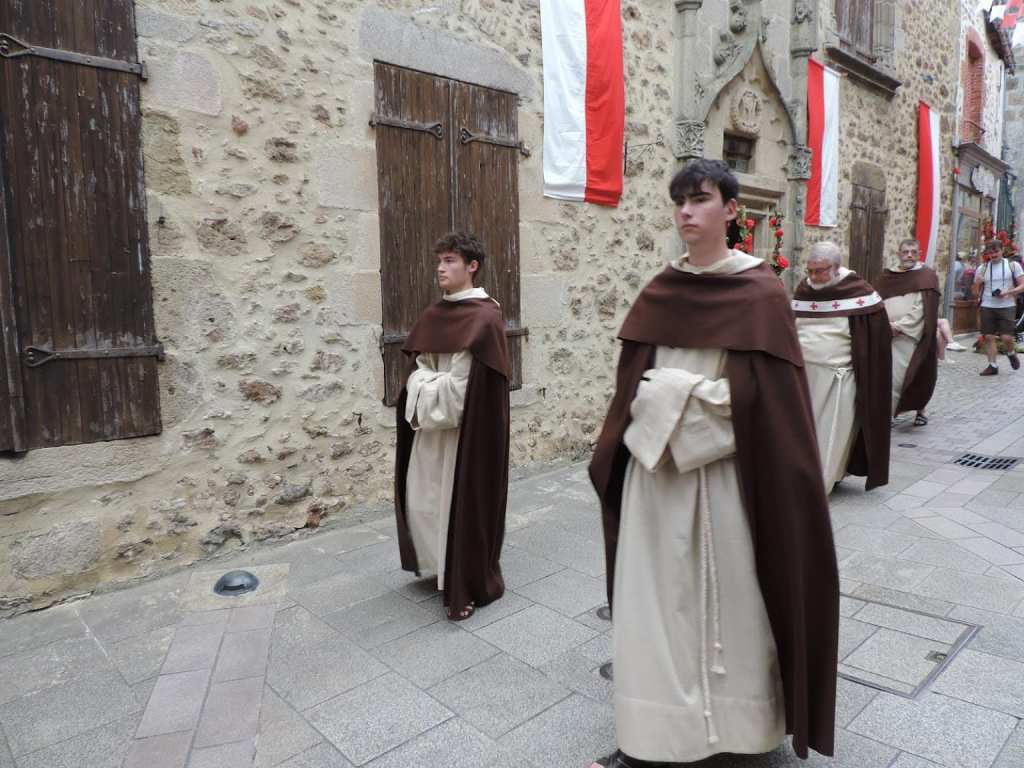
Sunday sees the great event. The procession is simple enough; there’s no dancing involved, or floats to be manoeuvred; just several hundred people in about fifteen groups, each telling a story from the life of a saint. The local saints are represented along with their relics, while a few others from recent times, like Charles de Foucauld, Therese of Lisieux, and Abbe Pierre, founder of the Erasmus movement, show something of developing devotion.
Once again the streets are closed off, this time over an hour before the start of the procession, with strategically placed cars across strategic junctions, a legacy of security alerts in recent times. Rochechouart boasts a population of 3,800; they will be joined by thousands of spectators and hundreds of participants from the surrounding villages and towns. About seven hundred people will parade in costume. And it’s basically at the pace of a gentle shuffle, along the boulevard into the streets of the old town, and back to the great square, the Place du Château. Jean Yves leads the way with the home team representing Saint Julien who is joined by a platoon of Roman soldiers to hint at days of martyrdom under the emperors.
Other groups represent local saints, or other saints who are locally favoured, and scenes of piety and faith. St John the Baptist and his disciples are there in heat-defying animal skins, the four evangelists proudly boast beards that have been grown out for the occasion, a tableau of the Miraculous Medal provides a visual break of soothing blue, and Saint John Paul II strides out alongside young people wearing the t-shirts from a scattering of world days for youth. Into the mix the Spirit of Pentecost adds a flash of colour.
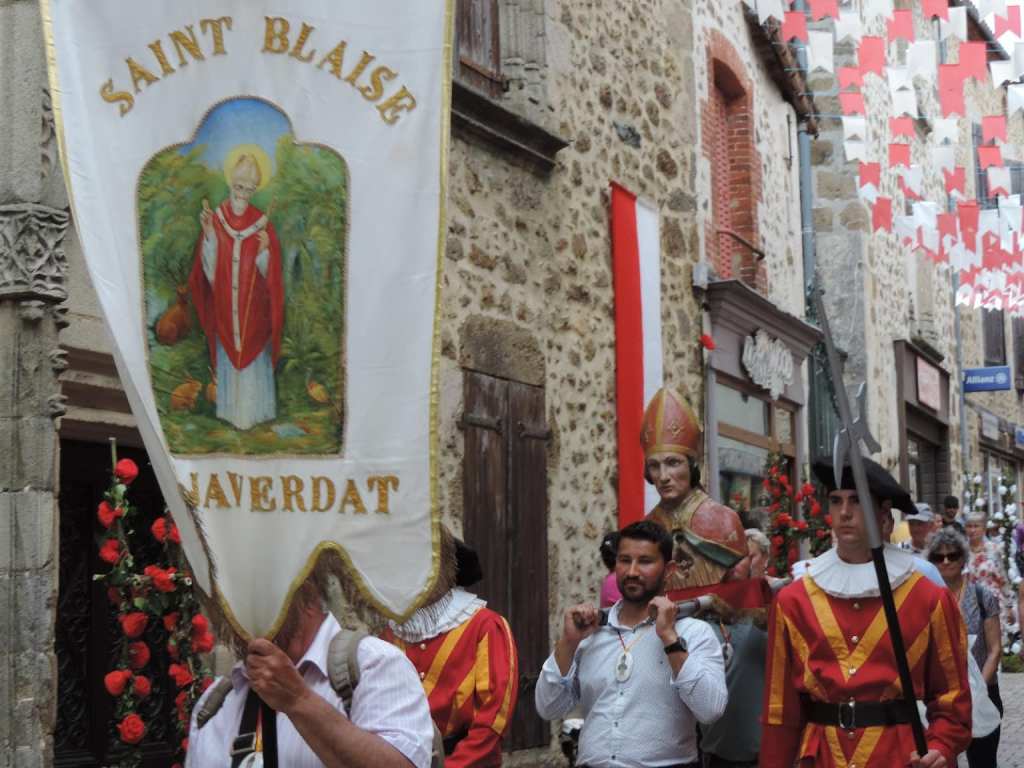
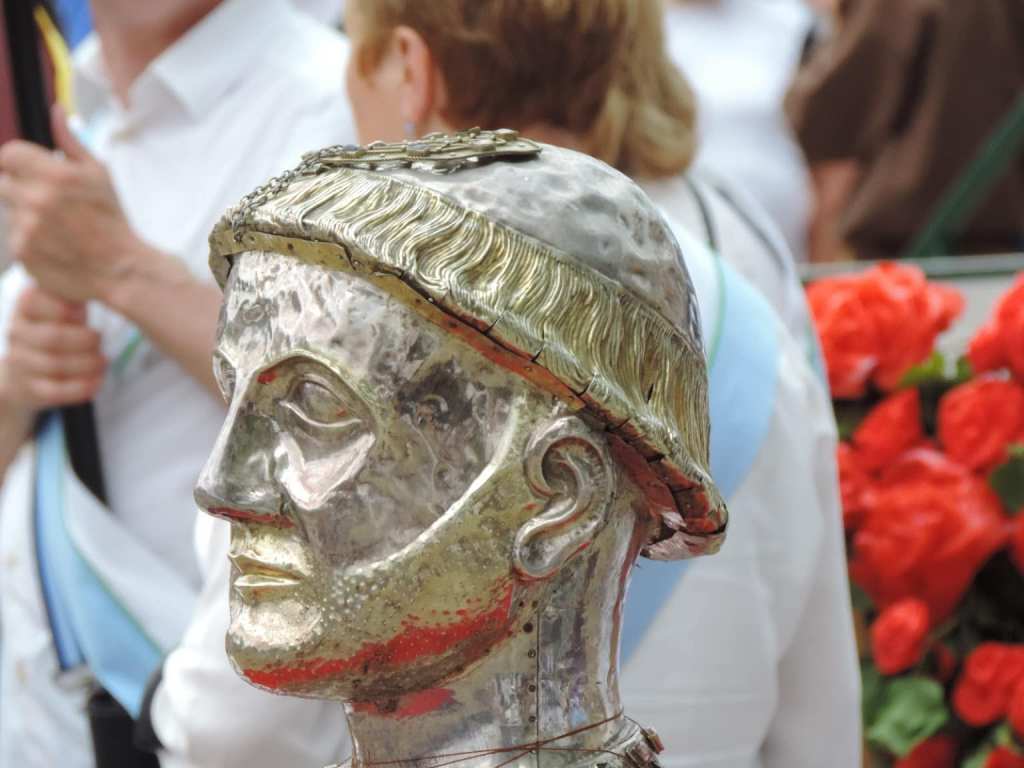
But it’s the local saints who spark obvious pride with colourful sash-wearing confraternities, and the chasses, floats carried at shoulder height to display the relics retrieved for the day from museums, church treasuries, and sacristy safes. The silver reliquary representing the head of Saint Yrieix, abbot in sixth century Limousin, stands out in sunlit magnificence. Others are more muted but nonetheless venerable. There is the mitred head of Saint Blaise, while Saint Victurnien, who might just about have come from Scotland, is accompanied by a man wearing Highland cloak and tartan. Aymerique, the local lord who established the town and its fortress was probably not the most saintly character but he stakes a claim through the founding of a church, whereas Cardinal Cramaud was a Rochechouart boy who rose to eminence from humble enough beginnings in the 15th Century.
It is magnificently, ostentatiously, over the top. And in Rochechouart it is certainly an expression of religious faith and tradition. I’m told that in one or two other towns, where politics has been of a more radically secular nature, there will be no relics or saints, just a celebration of medieval pageantry. Each to their own. This kind of religious display isn’t something that I ordinarily appreciate, but the exuberance is infectious, and the effort is wonderful, and perhaps like many of the participants, I’ll refrain from asking too many questions.
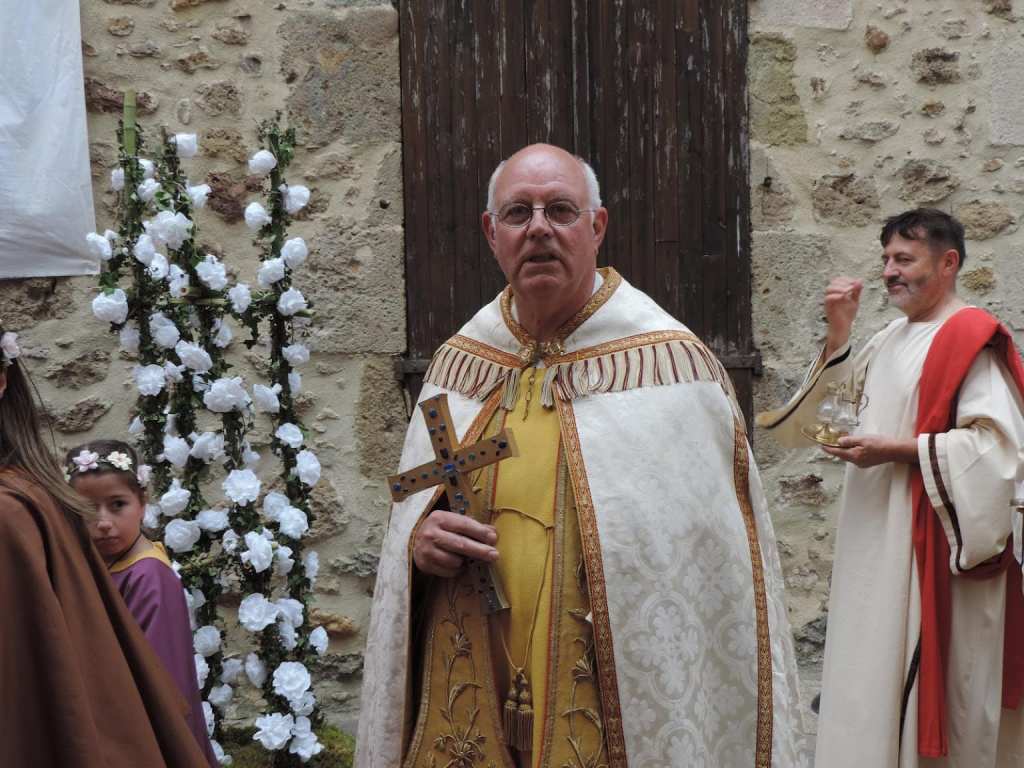
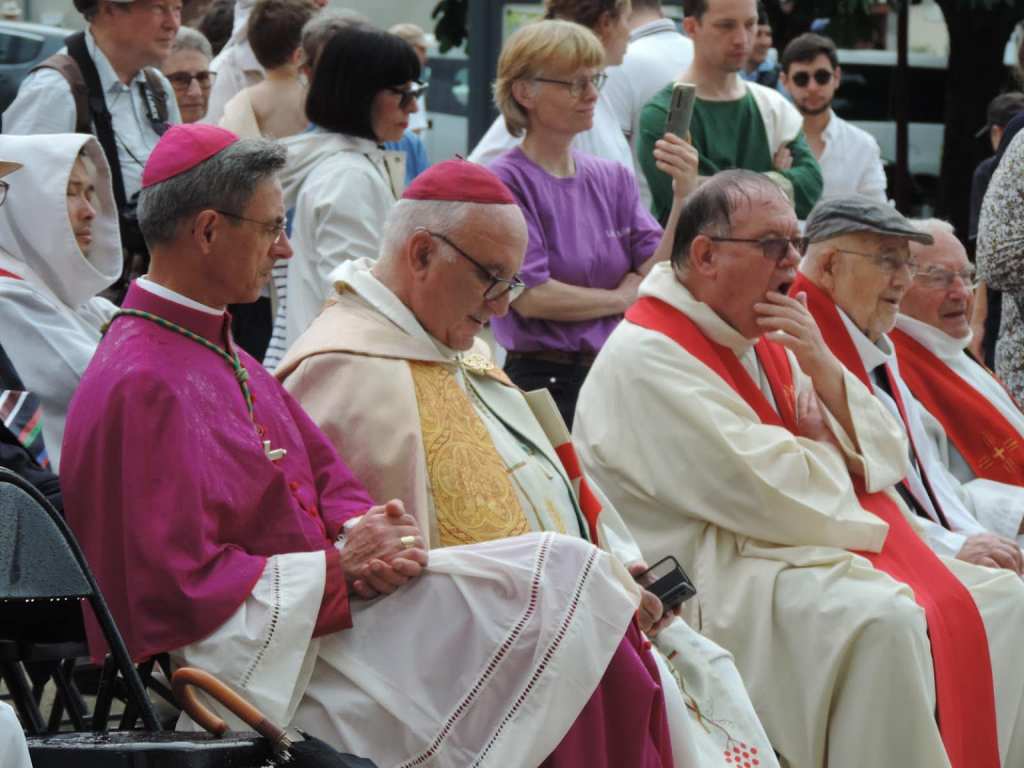
In the Place du Chateau the crowd gathers, the relics placed on a long table, local clergy and bishops sit in places of honour. There will be speeches; lots of speeches. Each village group is thanked, in turn, for their contribution. All of the volunteers who have made the event possible are mentioned in the Presidential address, but thankfully as a group rather than individually. The new bishop shares his joy at being part of his first Ostensions, a neighbouring bishop goes on a bit too long; and another thing and frankly …
And so it draws to a close for another seven years. By long-established tradition the committees will review this year’s events and conclude that they couldn’t possibly do it again. It’s all too expensive, too much work, and all for just a few days. But mostly it’s just too expensive. In a year or two these same minds will turn to what might be possible for 2030, and these volunteers will agree that they cannot be the ones who bring centuries of tradition to a close, and that it might just be possible to do something, perhaps not quite so grand as last time. It is, after all, a truly significant tradition, and a matter of great pride that such a body as UNESCO has recognised these Ostensions on their Representative List of the Intangible Cultural Heritage of Humanity.
Oh, if only the commune or the department could see a way around laïcité and provide a small grant, even a small contribution would be welcome.
But whatever the future holds, there is an obvious area for some serious research in the field of religious studies looking into what all those involved think about what it all means. Does the doing, the practice and physical display of the Ostensions, reflect an underlying attitude of faith, or is the ostentation enough in itself for now?






 Colin Brady
Thank you for a wonderfully evocative and inviting account of the Ostentation, Colin. As for Laicite… at the one of Trinity Sunday in Le Dorat, the Mass (celebrated by Cardinal Sarah) was relayed on plasma screens in the Grand Place, after which the Mayor joined the Cardinal, Bishop Bozo & the other clergy on the podium to view the processions (in which many of the mayors of surrounding communes took part). I was left with the impression that it was very much ‘faith in the public square.’
LikeLike
Hello Colin
I was visiting my brother Andrew (retired surgeon), who lives at Rochechouart, for the period of the Ostensions. It was lovely and your article captures it perfectly. Thank you, Meilleurs salutations. Robert
LikeLiked by 1 person