
Notes towards a family history of the Mulreany family of Killybegs, with reference to their links to the Wards of Faifannon and the Golds/Goulds of Ballyweell. I offer these notes in this rough format for the time being on the off-chance that they might be of interest to others researching the history of the Mulreanys in County Donegal.
One of the oldest photographs of Killybegs, taken in the 1890s, shows the church of St Mary of the Visitation overlooking the town and harbour. Just to the right of the church is a house and the clear outline of the wall around its garden. The double-fronted two-storey house is of a familiar design in rural Ireland; the sort of house one might associate with a reasonably comfortable farmer. By the end of the nineteenth century this had been the home of the Mulreany family for some sixty years, and Mulreanys would continue living on the site until 1994. The first Mulreanys to live in it were Patrick and his wife Bridget. The last of the family to live on the site were Patrick, known as Packie, and his sister Peggy, great-grandchildren of Patrick and Bridget.
Over time the sloping road between the church and the Mulreany home became known as Mulreany’s Brae, and a local heritage sign erected in 2022 recalls that tradition.
Another local tradition has it that for that first Christmas mass in the church, mindful of the lack of furniture in the new building, members of the congregation took handfuls of hay from the stack beside the Mulreany home, each thinking that a little hay would not be missed and would provide some cushioning as they knelt on the hard floor. But a handful of hay multiplied many times over meant that by the end of Christmas the fine stack had been radically depleted.
Work on building the church began in 1843 and the first service took place at Christmas 1844. The rocky site for the church was gifted by the local landlord, Alexander Murray. Patrick Mulreany had grazing rights on the hill at that time, and his house, garden, and some farmland, were also part of the Murray estate. No doubt there was some form of compensation for the loss of grazing but we can imagine that negotiation between landlord and tenant didn’t take up much time, for as well as being one of Murray’s tenants Patrick was one of his employees, described in records as an agent or bailiff.
That employee role tells us how the Mulreanys came to occupy such a prime location in the area. Below their garden was Admiralty House, later Aileach and now the site of the Community Hospital. Below that again was the White House, home of the principal land agent for the Murray estates in Donegal. The Murray school was next door, next to that the Coastguard station. The Church of Ireland parish church was nearby. That whole area, which lies within the townland of Corporation in Killybegs, was the administrative heart of an estate that ran from Killybegs up to Ardara, and along the coast towards Donegal town, encompassing some 50,000 acres.
Peggy Mulreany, the last of the name to live in Killybegs, had a family story that three Mulreany brothers moved from the Irish midlands to county Donegal to work as stone-cutters. That story makes sense as records for the distribution of the Mulreany name suggest that it is a spelling variant that only occurred in a very small number of households in County Offaly, and then in south County Donegal, with both locations with stone quarries.
In the mid-nineteenth century there were twenty-seven Mulreany households in Ireland; four in county Offaly in the parish of Killaderry, and the rest mostly concentrated around Inver, an area noted for its quarries and stone-mines. Thereafter all Mulreany births in Ireland seem to be in Donegal, suggesting that any migration from the midlands to the north-west involved most of the extended family.
Griffiths Valuation recording holdings of land and buildings in 1857 shows twenty-one Mulreany households near Inver, one household in Inishmacasaint near Ballyshannon (a Michael Mulreany renting a house), and one household in Killybegs where Patrick Mulreany had a house, land, and a yard, from HG Murray Stewart in the townland of Corporation.
An index of wills for the (Church of Ireland) Diocese of Raphoe records a will for James Mulreany of Drumlaughtafin, Dunkineely, in 1810. The Church of Ireland courts dealt with all wills at that time so the register points to no more than that a James Mulreany was sufficiently well-off to have made a will, and was in county Donegal in the early nineteenth century.
Records for Tithe Applotments show that five Mulreanys were required to pay tithes in the Inver, Donegal, and Killymard, parishes in 1825. The other Mulreanys in Ireland who are listed for tithes are three households located in Castletownkindalen just to the north of KIlbeggan, Co. Westmeath, another parish associated with stone quarrying in the early nineteenth century, and one in Moylough, Co. Galway.
In 1856 Peter Mulreany of Killybegs, a ‘land steward’ and son of Patrick Mulreany, was married at Glenties Registrary Office and gave his father’s position as ‘bailiff’. In 1884 the death of Bridget Mulreany is recorded in Killybegs. She is 86 years old and described as ‘widow of a bailiff’. The death is registered by her daughter, Dorah Mulreany. Patrick Mulreany died in November 1882, aged 80. Perhaps a bit more coyly, his position was given in the register of deaths as ‘farmer’.
So the records give us the first Mulreanys in Killybegs, Patrick and Bridget, and their son Peter, a daughter called Dora(h), and possibly another daughter, Mary Jane, for a Mary Jane Mulreany is a witness at Peter’s wedding. These Mulreanys lived in a house on what is now known as Mulreanys’ Brae in Killybegs, with some farmland outside the town. Described as originally being one and a half storeys high; it was mostly demolished in 1975, with garages built using the remaining ground floor walls. Also cleared away at that time were the derelict remains of a byre behind the house.
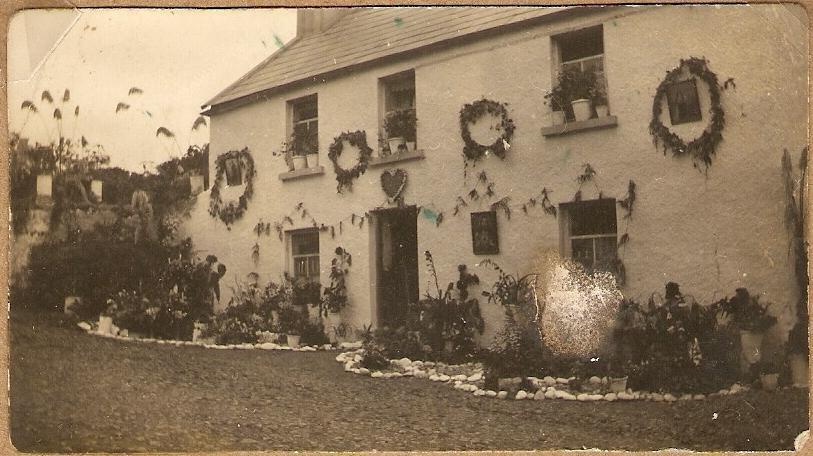
The old house, Mulreany’s Brae, possibly decorated for the Eucharistic Congress in 1932
Peter Mulreany, son of Patrick and Brigid Mulreany was born around 1828. Around 1853 he joined his father in working for the Murray Stewart estate as a land steward. We can imagine that the role might have taken him all over the estate, perhaps even as far as the parish of Killymard near Donegal town. For in 1856 Peter Mulreany eloped with Jane Gold from Ballyboyle where her father was a tenant of the Murray Stewart estate. Was the young man, starting out on a professional career, something of a catch?
We can imagine that Peter and Jane first saw each other as he made rounds of the tenancies on the estate. There must have been a strong sense of attraction for a story handed down over the years suggests that one evening she slipped out of her family home and went along the beach where Peter was waiting with a boat. The Golds were members of the Church of Ireland, the Mulreanys Roman Catholic; a difference that at the time could have led to objections to their marriage. The couple were married on the 24th April 1856 in the Registrar’s Office in Glenties, a civil ceremony avoiding those troubling religious issues. Peter would have been about twenty-seven years old, Jane was about twenty-one.
The couple set up home shortly afterwards, in Brackey near Ardara. The house is still there and still occupied by some of their descendants. It has an attractive setting on a bend in the road, next to a small river, with farmyard and adjoining fields. This was pretty much the northwestern corner of the Murray Stewart estate, perhaps a strategic location for the estate’s administration.
More information can be gleaned from Peter’s death in December 1893 at the age of 65. One of his sons registers the death and gives his father’s position as ‘farmer’. A newspaper report of Peter’s funeral gives more:
“The intelligence of the death of Mr. Peter Mulreany, assistant manager of the estate of Mr. H.G. Murray Stewart, was received with much regret by his many friends. The sad event occurred at his residence in Brackey, near Ardara, about three o’clock on the evening of Saturday the 9th inst. For some months past his health had been giving away, but it was not to within a week of his death that he became seriously indisposed. All that medical aid could do proved to be of no avail. Mr. Mulreany had been in the employment of the above-named gentleman and his predecessor for the last forty years, and few men in his position could have managed the affairs of the estate with greater clemency and justice. He was beloved of the tenantry, and outside the estate he also enjoyed a widespread popularity. In trying times he never failed to use his influence in favour of the poor, in whose welfare he had always taken a special interest.”
Amongst those listed as chief mourners at the funeral is a brother in law, Charles Gold, and WJ Gold, a nephew; an indication of at least some level of amicable relations years after the elopement.
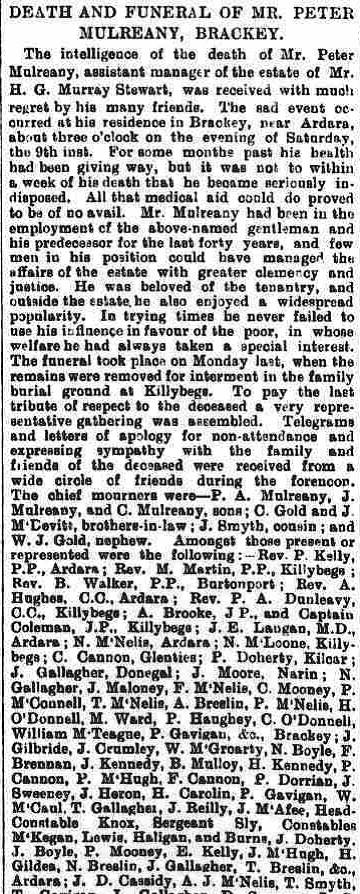
Funeral of Peter Mulreany
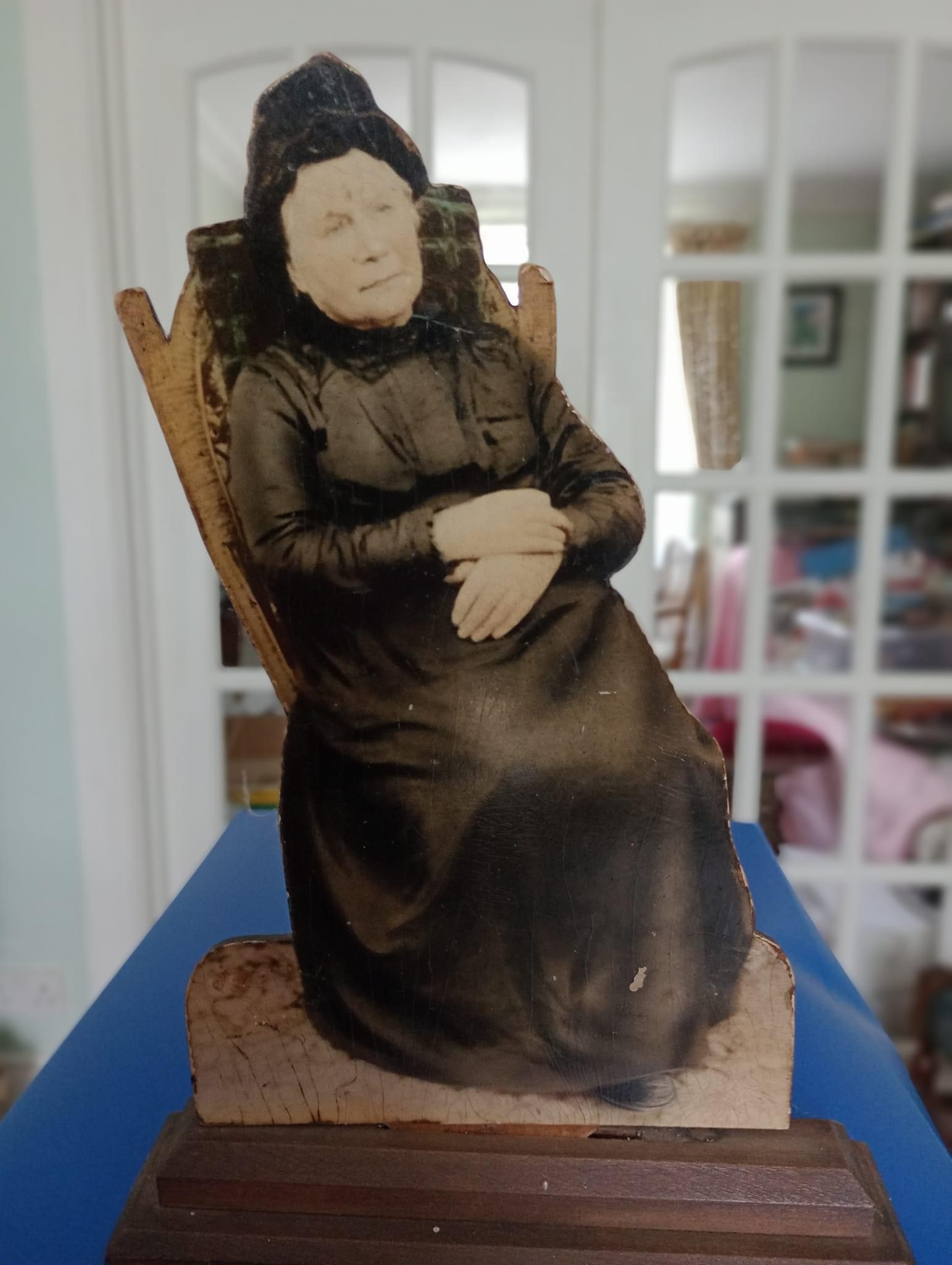
Jane Mulreany, nee Gold, in her later years.
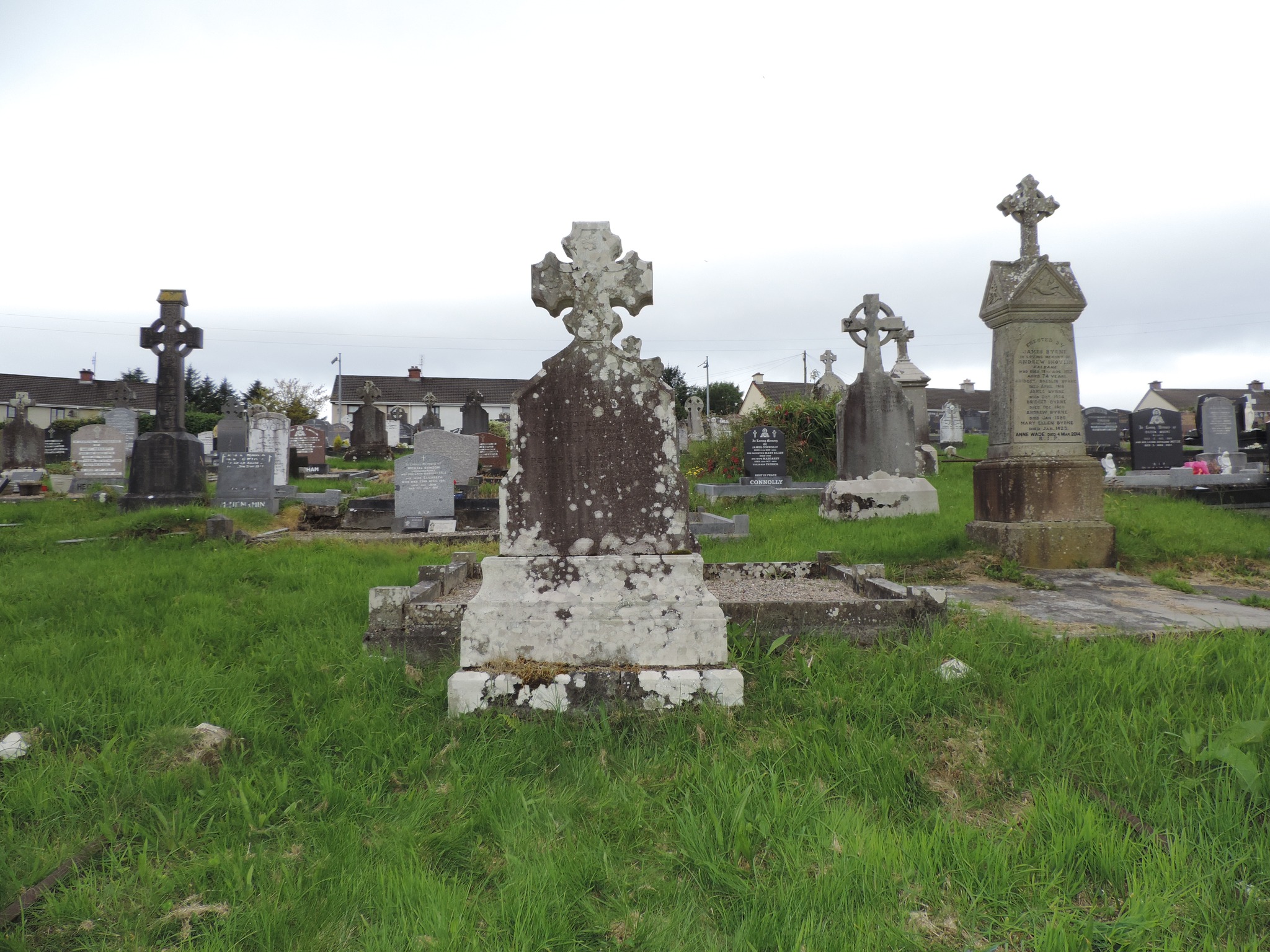
Grave of Patrick and Brigid Mulreany, their son Peter, grandson Peter Clement, and probably others including Jane Gold.
In 1894 John Mulreany, one of Peter’s sons, marries and gives his position as ‘farmer or bailiff’ and his late father’s position as ‘Bailiff and farmer’. John also worked for the Murray Stewart estate, and would be involved as foreman in the building of Brookehill house.
So Patrick Mulreany, born around 1802, moves to Killybegs to take up a position looking after some aspect of the Murray Stewart estate. It’s easy to imagine that it would have made sense for the estate to employ someone who was enough of an outsider to be free of local conflicts of interest. When we consider the amount of building work undertaken by the estate in the Killybegs area at that time perhaps we can surmise that Patrick, from a family that worked with stone, might have had some skills in masonry or the supervision of building works.
At one stage he is shown in the estate accounts to have some sort of responsibility for holding and for the distribution of poor relief rates. Griffiths valuation shows that he rents the house and some land from the Stewart estate, and a yard that may be the one known as the pound.
Patrick’s son Peter would join him in working on the estate and set up home at Brackey near Ardara. Again, he would have the house and farm as a tenant of the estate while working as one the estate’s agents. Eventually one of Peter’s younger sons, John, would also join the staff Murray Stewart estate, and have responsibility for overseeing building projects. John, however, had one of the terraced houses on Church Rd; the rewards for working for the estate were not what they had been.
Peter and Mary Jane had nine children of whom seven were still alive in 1911.
Patrick Augustine, Dora, and Brigid, became National School teachers. Charles remained at home as a farmer, and was active in the Ardara Dramatic Company, taking on roles in plays including Willy Riley, The Irish Tutor, and The Rebel of Inishowen. In 1901 Dora was listed on the census as housekeeper for Patrick Augustine in Killybegs, returning to Brackey presumably when he got married. Marian also continues to live at Brackey and was a seamstress. Christina married into the Melly family, and John, as previously mentioned, joined the Murray Stewart estate, married, and had a home in Killybegs. The two children who died, one in infancy and the other at the age of eight, were both called Peter.
Patrick Augustine is recorded as having been a monitor at Ardara Male National School in 1878, a teacher at Loughros Point NS, and Assistant teacher at North End National Schools, Larne, in 1890. About 1895 he was appointed to the Niall Mor school, and began living in what had been his grandparents’ home nearby. One of his sisters joined him as his housekeeper and that is the household recorded in the census 1901.
On the 10th February 1902 Patrick Augustine married Mary Ward, a teacher at the Commons School, in St Mary’s Church, Killybegs. The officiating priest was the bride’s brother, Fr. Michael Ward. Mary was the daughter of John Ward, another local schoolmaster, who was a published writer, and champion of the movement to revive the Irish language. Patrick Augustine and Mary had nine children of whom seven survived into adulthood: Mary, Patrick (Packie), Sean (birth registered as John), Charles (Fr. Joe), Anne, Thomas, and Margaret (Peggy).
Patrick Augustine was elected to Donegal County Council and took up the cause of poorer tenant farmers, arguing in 1928 for relief from arrears so that they could take advantage of land reforms to gain ownership of their farms (Derry People and Tirconaill News, 28 Apr. 1928):
‘… at the county council meeting on 24 April there was a more conciliatory tone expressed for those farmers in arrears of annuity payments. A motion proposed by Patrick Mulreany was passed; that owing to the prevailing conditions the payment of annuities and rates were impossible and that the council request that local TDs confer with the relevant ministers to seek the best means of relieving the present deadlock. Mulreany claimed there were more than thirty holdings that had no stock on them for the last thirty years and nearly all were in arrears and were it not for this people would pay to graze cattle on them.’
Mary Ward contributed to local musical entertainments singing duets with her sister Sarah at a charity concert in 1886; My Erin O, and Blanche Alpin. Music remained an important part of her life which she passed on to her children.
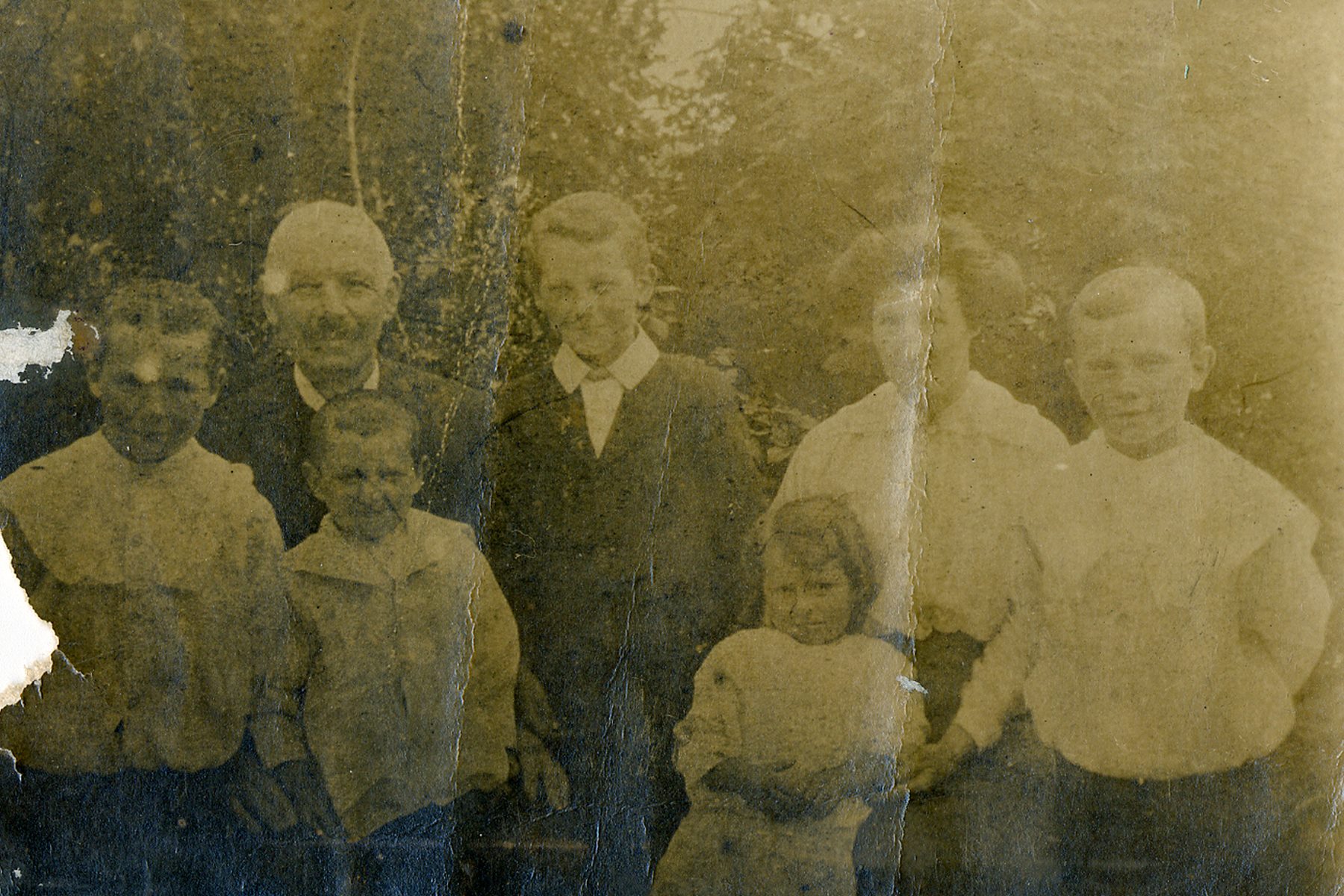
Patrick Augustine Mulreany and Mary Ward with children.
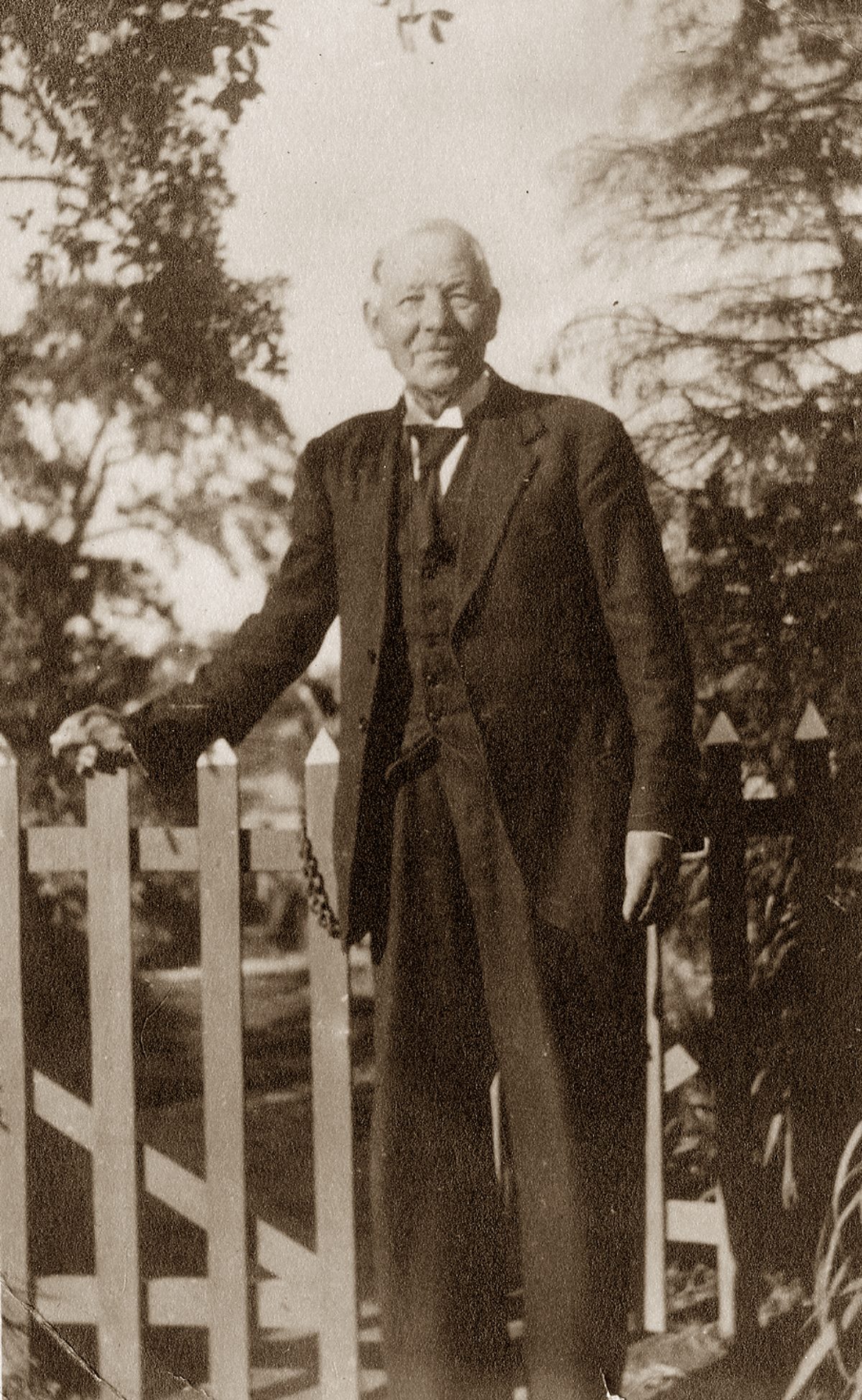
Patrick Augustine Mulreany, National School teacher, farmer, and County Councillor
Mary of Carrick, by Ethna Carbery
Mary Ward who married Patrick Augustine Mulreany in 1904 was a young schoolteacher in Carrick, Co. Donegal, when she became friends with Ethna Carbery and inspired this poem and song. The young schoolteacher would later provide translations into Irish for Ethna’s later projects including the journal, Shan Van Vocht.
Mary of Carrick has gone away
From our pleasant places, down to the sea,
She has put a loss on our mountain gray,
She has drained the joy from the heart o’ me,
Mary a-stor,
Mary a-stor,
Black hair, black eyes, I am grieving sore!
Mary of Carrick is small and sweet–
My Share of the World, how sweet were you
Tripping along on little bare feet
With your milking-pails through the rainbow dew?
Mary a-stor,
Mary a-stor,
The sun was a shadow with you to the fore!
Mary of Carrick gave only a smile–
No word of comfort for words I spake,
But since she left me, this weary while,
My heart is learning the way to break,
Mary a-stor,
Mary a-stor,
Quick is my learning–and bitter the lore!
Mary of Carrick, ’tis you I must follow,
For where you are ’tis there I must be–
On mountain gray, or in heathery hollow,
Or where the salt wind blows from the sea.
Mary a-stor,
Mary a-stor,
When I find I shall bind you. nor lose evermore!
Wikitree
A family tree of my grandfather, Partrick Mulreany (born 1906) can be found at https://www.wikitree.com/wiki/Mulreany-15
 Colin Brady